
Motor rewinding & balancing
Motor Rewinding & Dynamic Balancing Services in the UAE
Electric motor rewinding, overhaul and dynamic balancing for marine and industrial machines up to 900 kW — stripped, tested and rebuilt to Class H in our Sharjah workshop, with collection across Dubai and Sharjah.
The service
What an electric motor rewind actually replaces
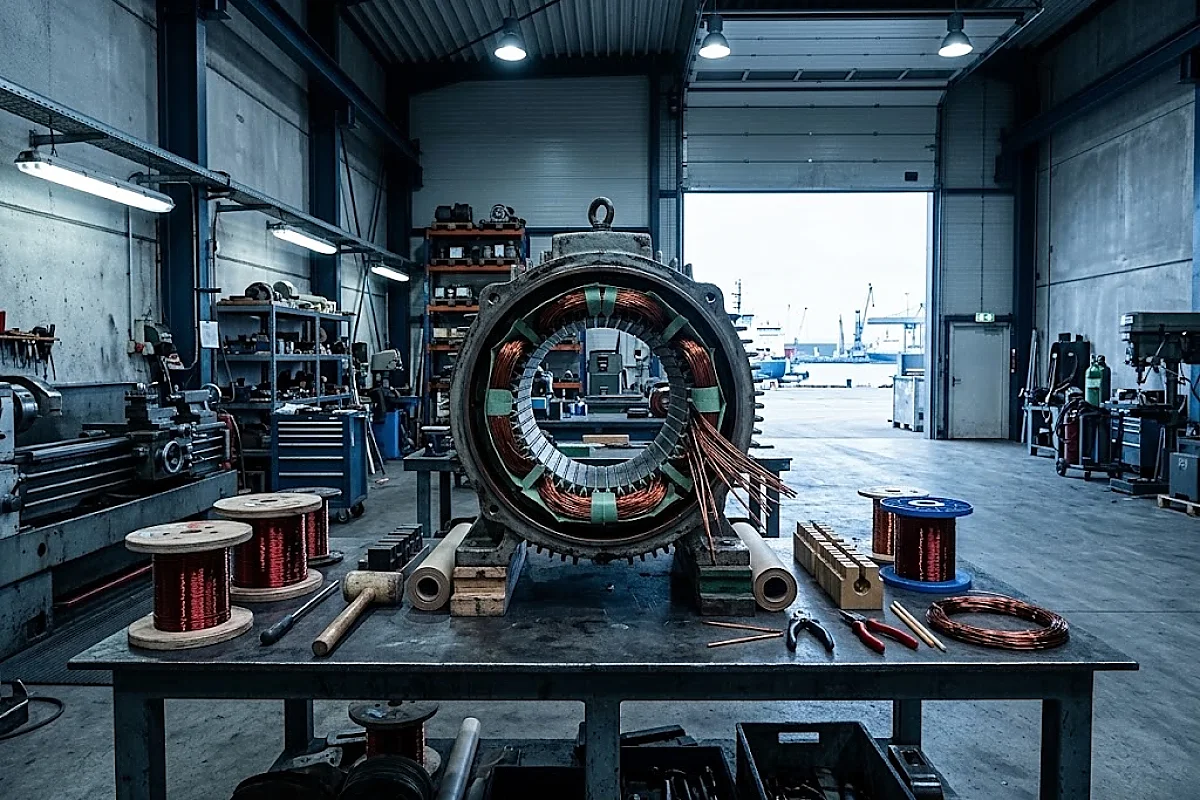
Almost every burnt-out motor fails the same way. The copper is intact; the insulation between turns, between phases and against the slot wall has degraded until a winding shorts, an earth fault trips the breaker, or one phase draws current the other two do not. Rewinding strips the failed winding out of the stator and replaces it — wire, slot liners, phase separators, wedges, connections and impregnation — so the machine returns to its original electrical design rather than being patched at the fault.
Nothing is quoted before the machine is open. The motor is stripped, the winding is recorded turn by turn — turns per coil, coil pitch, connection, slot fill and wire gauge — and insulation resistance is measured. The stator core is checked for hot spots and inter-laminar damage, the frame and end shields for cracks or picked-up bores, the shaft for scoring and run-out, and the cooling path for the dust and salt build-up that causes half the overheating cases we see. What we find goes to you in writing, with a rewind priced against a full overhaul.
Windings are rebuilt with Class H copper wire and insulation as standard. Most machines leave the factory Class F; in a UAE engine room or plant room the ambient alone eats much of the thermal margin before the load does, and salt-laden air finishes what heat starts. Specifying the higher class costs little at rebuild and addresses the reason the motor died rather than simply restoring it. Where a shaft, bearing housing or end shield needs recovery, it goes to our machine shop rather than out to a sub-contractor.
Back to all services →In short
What is motor rewinding?
Motor rewinding is removing the failed winding from an electric motor's stator or rotor and replacing it with new copper and insulation, wound to the original design. It is the repair a motor needs when the insulation has broken down rather than a bearing or a shaft having failed.
A motor that trips on earth fault, runs hot or draws uneven current between phases has usually lost insulation rather than copper. We record the winding turn by turn before it comes out, so the rebuild matches the original design instead of an assumption.
This sits alongside five other services in the same workshop — see about Best Anchor Marine Services for how the trades work together on one job.
Scope of work
Motors, generators and rotating assemblies we take on
Electrical and mechanical work sit in the same workshop, so a machine is not split between an electrical shop for the winding and a machinist for the shaft — it comes back complete, balanced and tested.
AC induction motors
— single and three phase, low and high voltage, up to 900 kW
DC motors
— armature rewinding, field and interpole coils, commutator work
Generators and alternators
— stator and rotor rewinding, excitation and AVR diagnostics
Marine duty
— propulsion and bow thruster motors, deck cranes, winches, windlasses and capstans
Submersible and pump motors
— centrifugal, multistage and borehole sets
HVAC and process
— chiller, compressor, AHU, cooling tower and blower motors
Mechanical overhaul
— bearings, seals, shaft, end shields, fan and cooling path
Dynamic balancing
— rotors, armatures and rotating assemblies to 2.5 tons
Shaft work
— sleeving, re-machining and hydraulic straightening of bowed shafts
Testing
— insulation resistance, winding resistance, run and load testing, vibration readings
Up to 900 kW
LV & HV
Class H insulation
Balancing to 2.5 tons
Vibration analysis
Armature rewinding
Shaft straightening
Workshop capability
900 kW
Maximum AC & DC motor rewinding capacity
2.5 t
Dynamic balancing capacity, rotors and assemblies
Class H
Copper wire and insulation used on rewinds as standard
LV & HV
Low and high voltage windings
When to call us
Signs a motor needs rewinding rather than another reset
Most motors give warning before they stop. These are the symptoms worth acting on, and what each one usually means once the machine is open.
Tripping on earth fault
— insulation has broken down to the slot wall or the terminal box
Unequal current between phases
— shorted turns in one phase, or a failing connection
Running hot at normal load
— blocked cooling path, degraded insulation or a winding losing its class
A burnt varnish smell
— the winding has already overheated, whatever the meter says
Low or falling insulation resistance
— moisture ingress and ageing; trend it rather than wait for the trip
Vibration or a rumbling bearing
— imbalance, misalignment or bearing wear, which readings taken before and after separate
Slow to start or stalling on load
— winding fault, supply problem or a mechanical bind in the driven machine
Repeated overload trips after a reset
— the machine is telling you the fault is inside it, not in the starter
How the work runs
From arrival in the workshop to return to service
The sequence is the same for a deck winch motor and a chiller motor. It exists so the findings and the cost are agreed before anything is committed, and so the machine is proven before it goes back.
01
Strip, inspect and test
The motor is dismantled, cleaned and inspected. Insulation resistance is measured, the core and frame are checked for damage, and the shaft, bearing seats and cooling path are assessed so the fault is identified rather than assumed.
02
Winding data recorded
Turns per coil, coil pitch, connection, slot fill and wire gauge are written down before the old winding comes out, so the rebuild matches the original design instead of a generic equivalent.
03
Written finding and quotation
You receive what we found, what we recommend, and the cost of a rewind set against a full overhaul — including the cases where replacement is the better buy. Work starts once you agree the scope.
04
Rewinding
New coils are wound and inserted with Class H wire, slot liners, phase separation and wedges, then connected, tested and impregnated so the winding is sealed against moisture and held against vibration.
05
Mechanical overhaul
Bearings and seals are replaced, the shaft and housings are recovered where needed in our own machine shop, and the fan and cooling path are restored.
06
Dynamic balancing
The rotor or armature is balanced to 2.5 tons capacity, with vibration readings taken before and after so the correction is demonstrated rather than claimed.
07
Final testing and despatch
Insulation resistance, winding resistance, direction of rotation and a run or load test are carried out, and the machine is returned with the readings.
Applications
Dynamic balancing, vibration analysis and shaft straightening
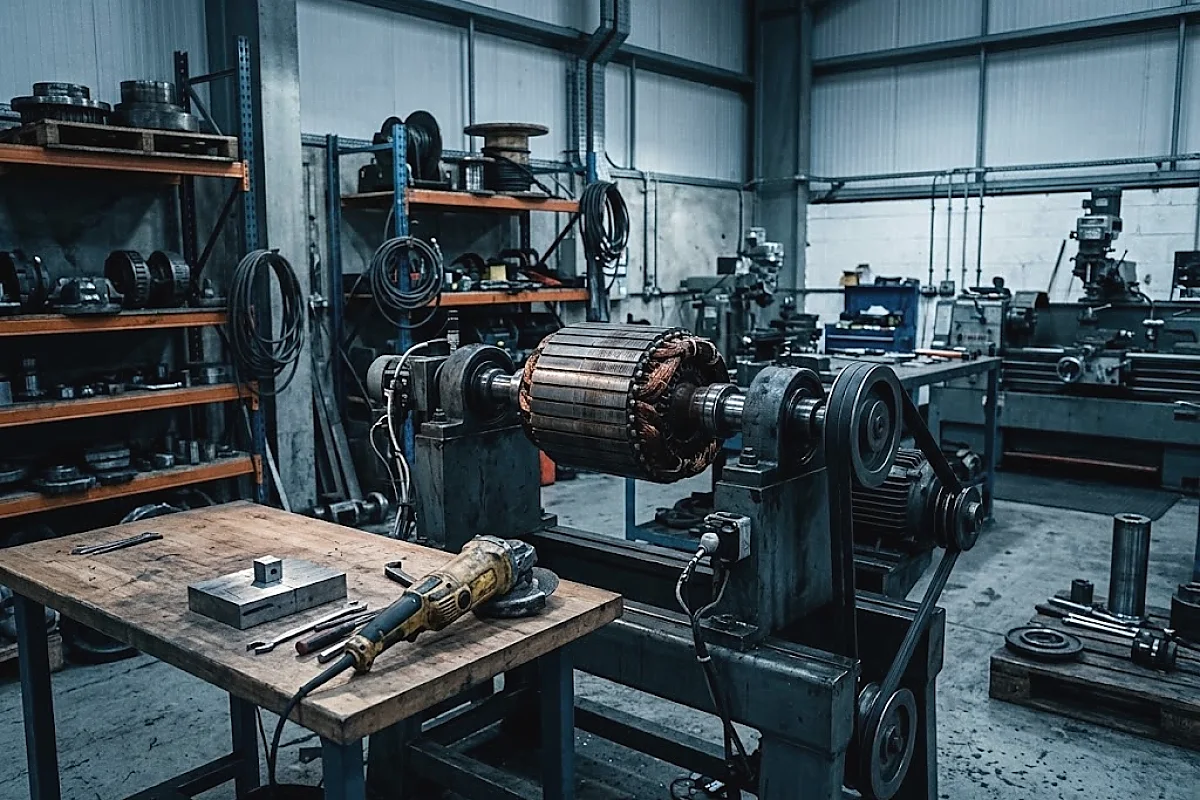
Imbalance is a force that grows with the square of speed, and it is paid for in bearings, seals and couplings long before the machine stops. We balance rotors, DC armatures and rotating assemblies up to 2.5 tons — pump and fan impellers, cooling tower and HVAC blower fans, flywheels, couplings, propeller and drive shafts — in the workshop, and every rotor we rewind is balanced before reassembly as part of the job.
Vibration readings are taken before and after so the correction is proven. That order matters: imbalance, misalignment, bent shafts, bearing defects and soft foundations all show up as vibration, and each needs a different fix. Balancing a machine whose real problem is a worn bearing or a slack holding-down bolt simply moves the symptom. If your specification calls for a particular balance quality grade or residual unbalance figure, send it with the enquiry and we will confirm what we can hold on the machine.
Balancing and vibration work is taken on as standalone work for equipment we have not rewound — including rotating assemblies that come from a pump or engine overhaul elsewhere on the same vessel.
Vessels, offshore support craft, tugs, barges and shipyard equipment
Chiller plant, air handling units, cooling towers and building services
Water treatment works, pumping stations and irrigation sets
Cranes, hoists, winches, windlasses and conveyor drives
Workshops, process plant and standby generator installations
Ship owners & managers
Shipyards
Offshore support
HVAC contractors
Industrial plant
Water treatment
Facilities management
Before you enquire
What to send with a motor rewinding enquiry
A clear nameplate photograph answers most of the specification. Where the plate is missing or painted over we work from the machine itself, so send what you have and we will tell you what else is needed.
Nameplate photograph
— kW or HP, voltage, frequency, full load current, rpm, frame size, insulation class, IP rating and duty
How it failed
— tripping, overheating, noise, vibration, a failed insulation test or a refusal to start
What it drives
— pump, fan, compressor, winch, thruster or conveyor, and how many hours it runs
Scope you want
— rewind only, rewind with mechanical overhaul, or balancing alone
Site details
— whether the motor is coming to the workshop or needs collection in Dubai or Sharjah
FAQs
Motor rewinding and balancing questions
Related services
Work that often runs alongside this
Motor work regularly turns up something mechanical, something electrical or a control fault that has to be put right at the same time. These run out of the same workshop, under one scope.
Request a quote
A nameplate photograph is enough to start
We will confirm what the motor needs, what it costs, and whether a rewind, a full overhaul or a replacement is the sensible call. Breakdown work considered — tell us the vessel or plant and when it has to be back.