
Heating elements
Screw plug immersion heaters, made to the thread you have
Threaded immersion heaters manufactured in Sharjah for tanks, small vessels and process lines. Made to the boss already welded into your vessel, with the element length, sheath and terminal enclosure set by the duty.
Home › Services › Heating Elements › Screw Plug Immersion Heaters
The product
What is a screw plug immersion heater?
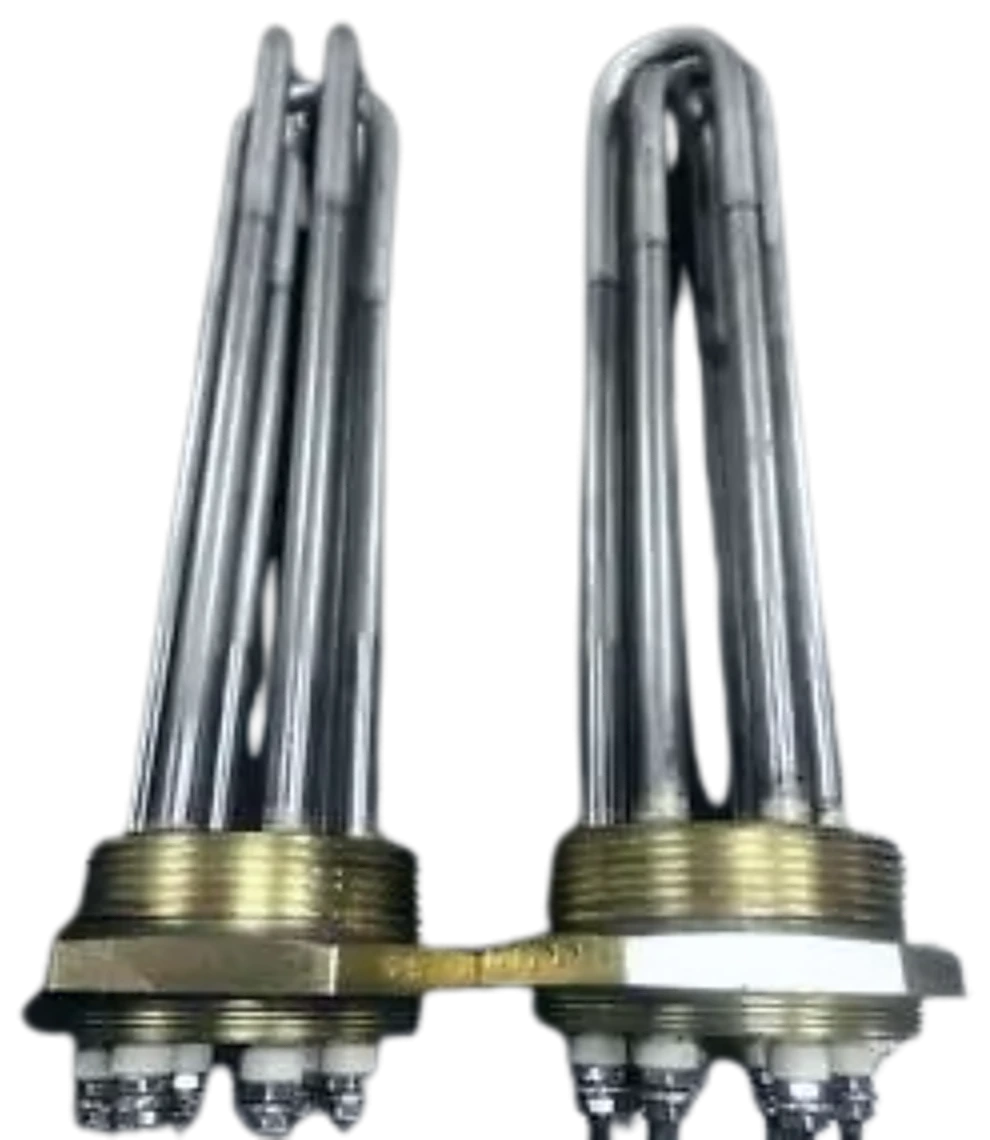
A screw plug immersion heater is a set of tubular elements brazed into a threaded plug, which screws into a boss or coupling on a vessel so the elements sit directly in the liquid. It is the simplest immersion mounting there is: one threaded joint, no flange, no gasket ring, and the whole unit comes out by unscrewing it.
That simplicity is the reason it suits smaller vessels and lighter loads. A threaded plug can only carry so much weight and only seal so large an opening, so once the bundle gets long or the load gets high the duty moves to a flanged unit instead.
We manufacture these to order against the fitting you already have. Thread form and size, element length, sheath material, terminal enclosure and any thermostat pocket are all specified for the job rather than picked from a range.
Not sure which mounting you need? Industrial immersion heaters compares the flanged, screw plug and inline options side by side.
Construction
How a screw plug heater is built
Everything hangs off one threaded joint, so the thread, the seal and the element length have to be right together. These are the parts we specify for each job.
Threaded plug
— cut to the thread form and size of the boss in your vessel, so it seals against the fitting that is already there
Element bundle
— tubular elements formed into hairpins and brazed into the plug, sized to the load and to the clearance inside the vessel
Sheath
— chosen against the medium and the working temperature, the same way it is on any immersion element
Terminal enclosure
— sized for the connections and specified for where the unit sits, indoors, in a plant room or exposed
Cold sections
— unheated length through the plug, so the thread and the terminals are not carrying heat
Thermostat pocket
— fitted where the control scheme needs sensing at the element rather than elsewhere in the vessel
Made to order
Made to sample
Made to drawing
Repeat batches
Selection
How to select a screw plug immersion heater
Two of these matter more on a screw plug unit than on any other mounting: the thread, and whether the bundle stays covered. Get those right and the rest follows.
The thread you actually have
— form, size and whether it is parallel or tapered. Measure it or photograph it against a rule; assuming a size is the most common cause of a unit that will not seal on site.
Load against mounting
— a threaded plug suits lighter loads and shorter bundles. If the load needs a bundle the thread cannot reasonably carry, the honest answer is a flanged unit, and we will tell you so.
Immersed length and clearance
— how deep the vessel is, where the fitting enters and what the element will foul on the way in. Elements can be formed around obstructions where the vessel is awkward.
The medium
— it sets the sheath material and puts a ceiling on watt density. Oil, water and treated or chemical fluids each behave differently against a hot sheath.
Scale and sediment
— in hard water an element near the bottom of a tank collects sediment, which insulates it and cooks it. Where the water is hard, position and density both need easing.
Control and protection
— where the sensor sits, what switches the load, and whether a separate over-temperature cut-out is required.
Applications
Where screw plug heaters are used
Screw plug units suit the smaller end of the same work the flanged ones do: modest tanks, small calorifiers, oil sumps, day tanks and process vessels where the load is light and the connection is a threaded boss rather than a flange.
They are also the usual replacement on older equipment, where a threaded fitting was welded in years ago and nobody wants to cut the vessel to change the mounting. Making a new unit to the existing thread avoids that entirely.
Small hot water tanks and package water heaters
Fuel oil day tanks and lubricating oil sumps
Small process and dip tanks
Anti-freeze and frost protection on outdoor vessels
Auxiliary heating on marine and offshore equipment
Like-for-like replacements on vessels with an existing threaded boss
Marine
Industrial plant
HVAC
Facilities
Offshore
Quotation
What to send with your enquiry
A photograph of the old unit beside a rule answers most of this at once. If you are specifying from scratch instead, these are the details we need.
Thread form and size, and whether it is parallel or tapered
Supply voltage, phase and the load required
Overall and immersed length, and the depth available in the vessel
The medium being heated and its working temperature range
Whether a thermostat pocket or over-temperature cut-out is needed
Photographs of the failed unit, the boss and the terminal box
FAQs
Screw plug immersion heater questions
Related
Related heating elements
Other mountings and element types for the same kind of duty.
Request a quote
Measure the boss, not the old heater
A photograph of the old unit against a rule is usually enough to start. Workshop at Al Sajaa Industrial Area in Sharjah; we attend across Dubai and Sharjah.